EVA Mat Density Explained: 80 vs 120 kg/m3 and What It Means for Your Floor

If you have ever compared two EVA mats that look identical side by side — same color, same thickness, same tile size — you have probably wondered why one floor lasts for years and the other starts dipping and creaking within a season. The answer is usually a single number that never shows up in a photo: density, measured in kg/m³.

What density actually means in EVA foam

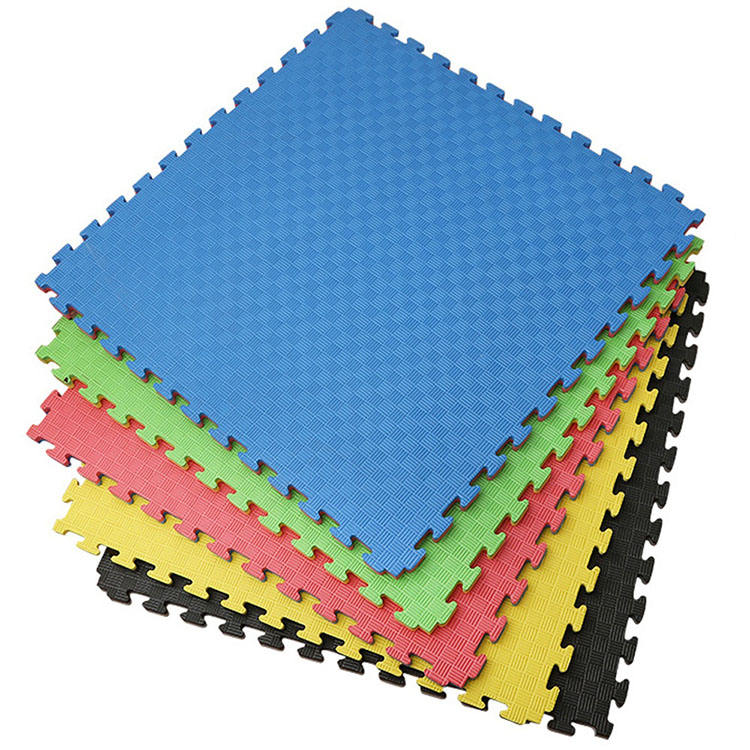
Stacked interlocking EVA mats in blue, red, green and yellow showing tile edges and thickness

EVA mats are made by foaming a closed-cell material into a sheet. Density describes how much material is packed into each cubic meter of that foam. In the flooring trade, EVA mats are commonly quoted somewhere in the 80–120 kg/m³ range, and that range covers products that behave very differently in daily use.

A lower number means more air and less material. A higher number means the cell walls are thicker and closer together. Neither is “wrong” — but each density band is right for a different job, and problems start when the band does not match the load the floor has to take.

80 kg/m³ vs 120 kg/m³: the practical difference

  • Compression set. A tile at the low end of the range recovers more slowly after being squeezed. Under a squat rack or a machine that sits in the same spot every day, low-density foam gradually flattens and stays flat.
  • Edge integrity. Interlocking mats connect through their puzzle teeth. On lower-density foam, those teeth deform first, and once a tooth deforms the gap keeps widening with every training session.
  • Feel underfoot. Higher-density foam feels solid and quiet underfoot; low-density foam feels hollow, transmits more impact noise, and bottoms out faster under point loads.
  • Lifespan. Two floors that look the same on day one can age completely differently: a 120 kg/m³ tile in a free-weight zone can outlast an 80 kg/m³ tile in the same spot by years.

How to match density to the application

  • Home play areas and light use — mid-range density is enough; comfort and fall cushioning matter more than compression resistance.
  • Commercial gyms and free-weight zones — stay at the high end of the range. Point loads from dumbbells, racks and sleds are exactly what low-density foam handles worst.
  • Martial arts, judo and taekwondo — higher density with a tatami texture gives the grip and impact absorption that throws and takedowns demand, without the mat bottoming out.
  • Multi-use studios — zoning works better than compromise: thicker, higher-density tile where loads are heavy, thinner tile under cardio machines.

The spec sheet to ask for before ordering

Before comparing prices between suppliers, pin down the numbers that actually decide how the floor will age:

  • Density band for your order — not just “high density”
  • Tile sizes: 100×100 cm, 60×60 cm and 30×30 cm interlocking options
  • Thickness from 1 to 5 cm, matched to the zone it will be laid in
  • Surface patterns such as five-line, T-pattern, leaf and tatami textures
  • Compliance: CE, EN71 and REACH-SVHC, with formamide-free foaming for kids’ areas

As a manufacturer, we quote the actual density band of every order instead of hiding behind “high density”, so buyers know exactly which end of the 80–120 kg/m³ range they are getting. If you are specifying a floor for a gym, a dojo or a studio, tell us the load profile and the zone layout — we will come back with a density and thickness suggestion for each zone before you commit to a single price.

Product Enquiry